
Seashell Graveyards
and questions without answers

Yesterday morning, I felt exuberant in gratitude because I feel hormonally whole again for the first time in years. To be able to have a relationship with my body again— to feel comfortable in it, and to love being in my own company throughout the moments of my days… the only thing I know to do with these emotions is blast my music when I drive, and sing with all my lungs. I want to share the news with everybody, and I want to keep it all to myself.
Two hours later, I read the news that at least *168+ girls had been bombed to death in their elementary school in Iran. I grappled with the unjust juxtapositions of this world. How is it that I am feeling unspeakable joys in my small life when violent atrocities are being havocked upon others? Why is it that I get to come back to life when so many young girls will never even live through the heartbreaks and accomplishments on their way to becoming my age? How could both be true at once?
In our Grief and Loss class, we discussed child death, and how the experience of grief is different for each sibling and parent in the family unit, as each internal experience fights to make sense of an external reality that is somehow without that person, and also interacts with the other members’ experiences in dynamicism. As time passes, grief oscillates between being in the loss and being in the restoration of life after loss. The oscillation may grow in length as it makes space for normalcy, but it never stops.
Oftentimes classmates share their experiences of loss as we learn these concepts, and the love and vulnerability in the room is palpable. I find myself thinking of how beautiful the word “grief” is. The soft g; the tenderness of the letters bundled together by curving ends.
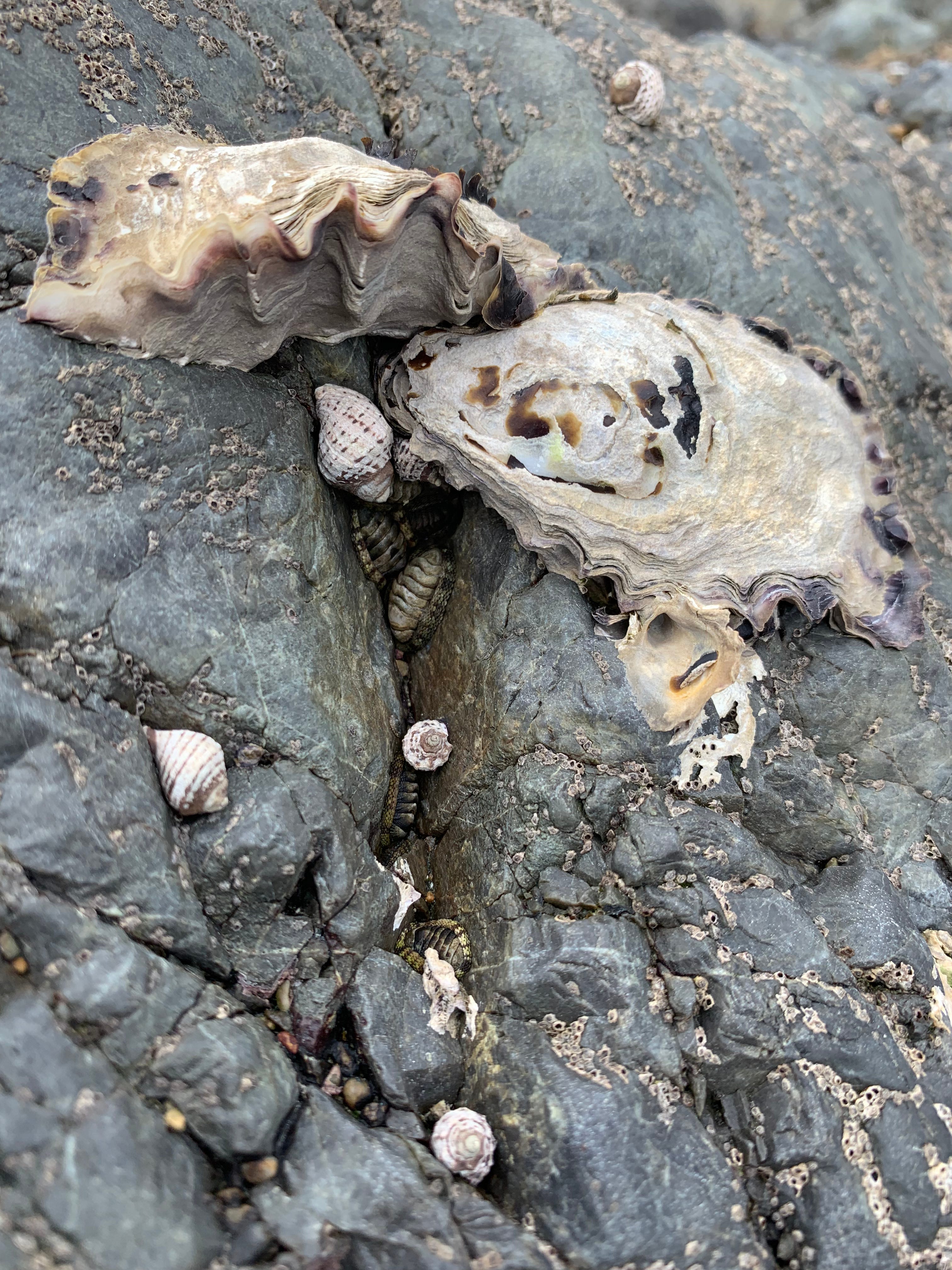
I’ve been thinking this week, in the background, about seashells. I have always loved seashells.
Specifically, I’ve been thinking about the fact that seashells are skeletons. I first realized this when I was eleven or so. There was something on the sand that looked so much like a sand dollar, except that it was fuzzy and dark green. My dad told me that it was still alive and helped me put it back in the ocean.
All seashells once held living mollusks. The mollusks build their shells out of calcium carbonate that has fallen from the nearby rock or cliff formations and made its way to the ocean floor. In a way, the seashells are a softer counterpart to our calcium phosphate bones.
It’s strange that we pocket and treasure the remains of these creatures’ bodies and lives’ work, and that we walk as tourists over their graveyards that serve as our romantic or rejuvenating destinations— But when it comes to our own dead, we have somber, formal rituals and tend to bury them in boxes far out of sight.
Within the encasement of our rituals, we all grieve differently— both as individuals and anew for what each loss represents to us. In the Grief and Loss class, we’re learning about cultural variants that make sense of the insensible phenomenon of death. Many East Asian cultures see death as the most significant life transition. The Ifaluk people (from a Pacific atoll) have words for grief such as lalomweiu, which loosely translates to loneliness combined with sadness, and fago, compassion combined with love and sadness.
I wonder if living closer to the sea makes it easier to understand the oscillatory nature of life and death and everything moving porously in between: water in the air, breath through us and between us, sand granules becoming bone, dendrites in our brains and in root systems beneath us, wiser than we will ever be. The circle of life that cartoon lions sang to us about when we were children, and that we can see for our very eyes in the sunrises and sunsets over these life-giving graveyards.
I think about the multiple truths in the breaking news stories. The sensation of foreboding that Iranian residents had as they prepared for a bomb strike, and the hope that they express for a better regime; that this horrific invasion could somehow be perceived by them as a welcome change. As both.
I wonder what the girls were learning in class that day.